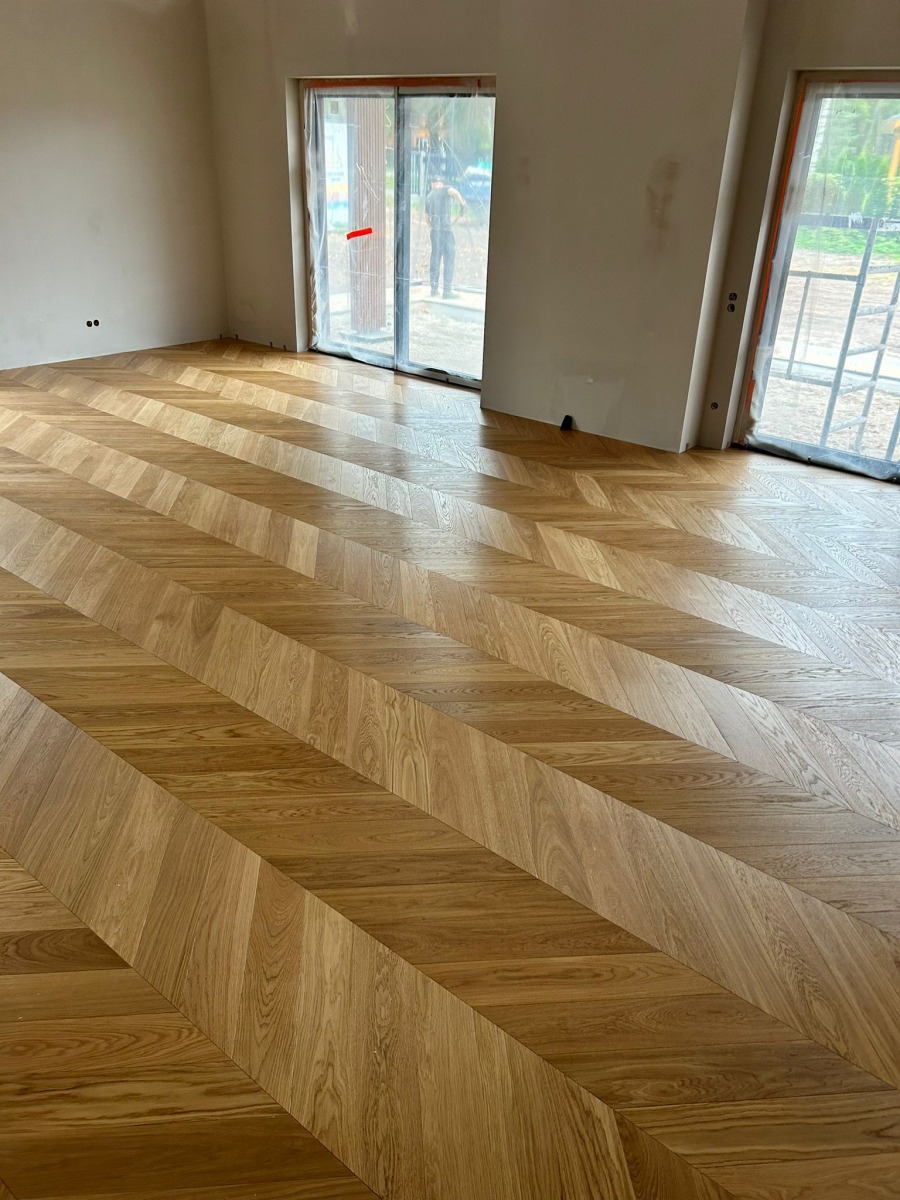
Chevron vs Herringbone Flooring |
← |

Written by PerfektoWood production team — European manufacturer of solid oak chevron and herringbone parquet flooring, Lithuania.
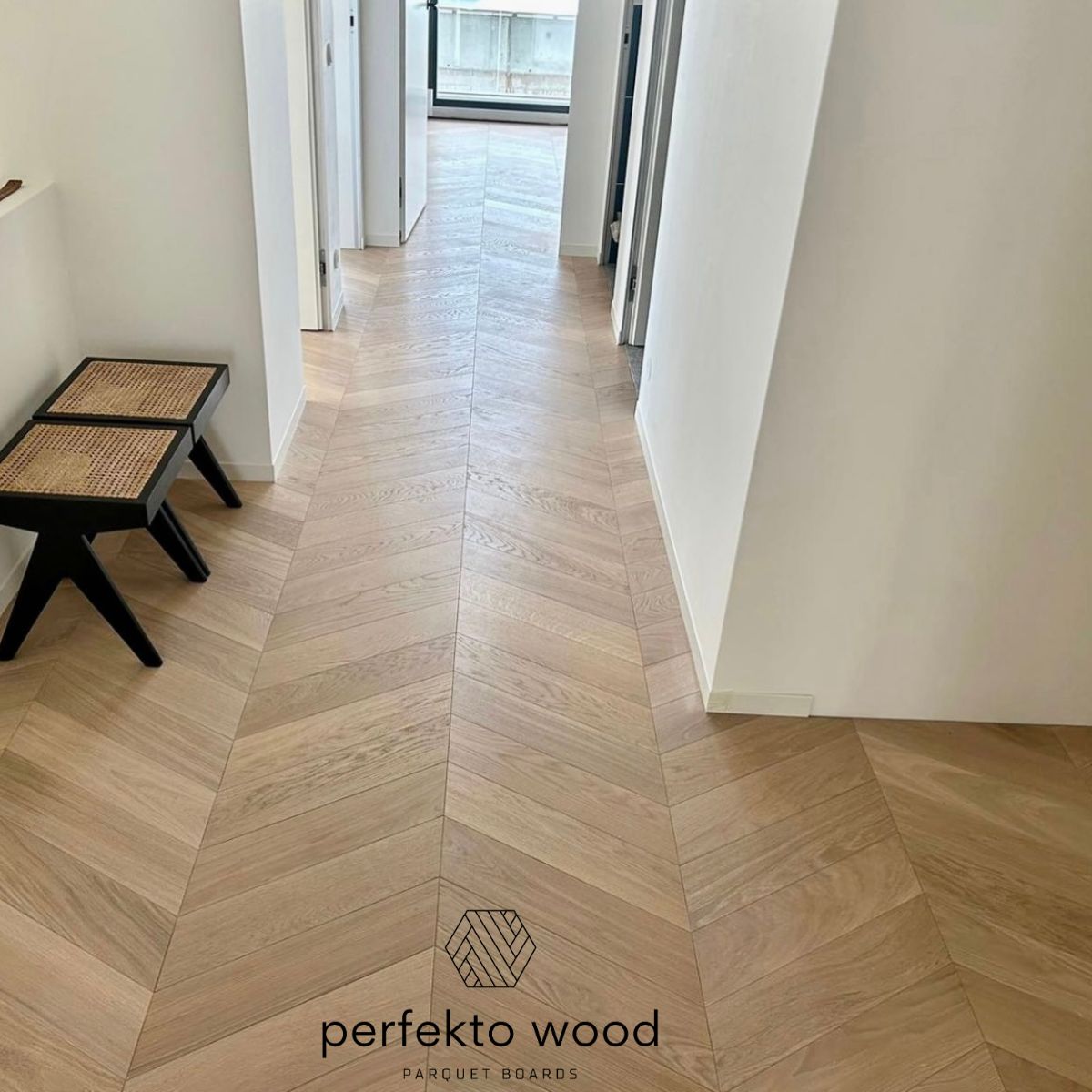
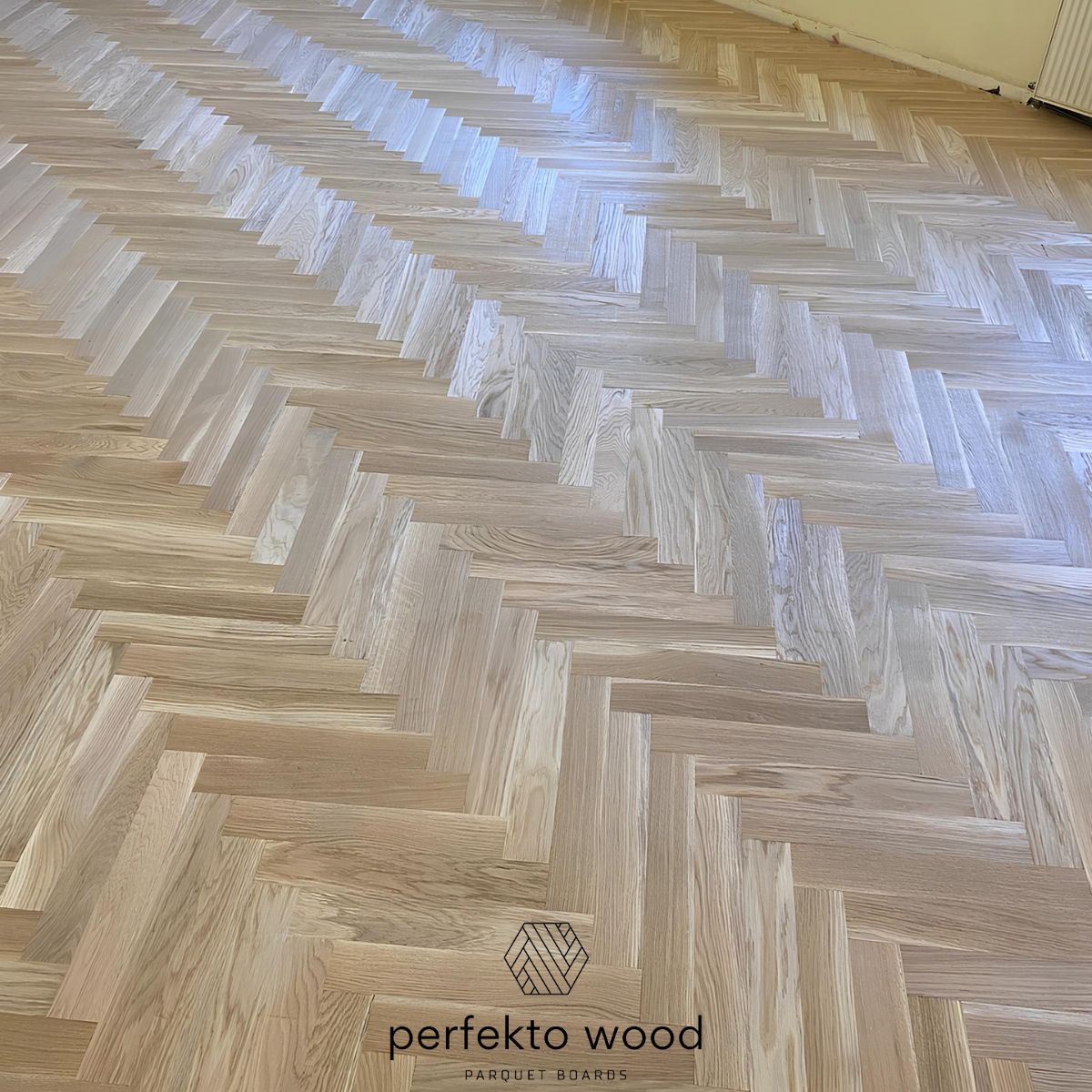
Chevron and herringbone are the two most specified parquet patterns in European architecture. They look similar at first glance — both use oak boards in a geometric layout — but they are fundamentally different in production, installation behaviour, and visual effect. This guide explains those differences from a manufacturer's perspective.
The key visual distinction comes from how the boards meet at the join line.
| Feature | Chevron | Herringbone |
|---|---|---|
| Pattern shape | Continuous unbroken V | Staggered zig-zag |
| Board ends | Angled — meet point to point | Square — end meets side |
| Visual effect | Directional flow, modern | Classic rhythm, timeless |
| Centre line | Clean unbroken spine | No centre line |
Chevron creates a strong directional arrow along the floor's central axis. Herringbone creates an interlocking texture without a dominant direction — more neutral, more adaptable.
From a production standpoint, this is where chevron and herringbone diverge significantly.
Chevron boards are cut at a precise angle — either 45° or 60° — on both ends. Left-hand and right-hand boards are mirror images of each other. The ends must meet with zero gap at the V-point during installation. This requires:
At PerfektoWood, solid oak chevron is manufactured in 45° and 60° angles across 9 standard dimensions. See our solid oak parquet construction guide for technical specifications.
Herringbone boards are rectangular with standard 90° square cuts on all ends. Production is more straightforward — no angular milling required. This means:
Manufacturer's conclusion: Chevron demands higher production precision and carries a corresponding cost premium. Herringbone is more efficient to produce and more forgiving to install.
Architect's note: Chevron angle matters. A 45° chevron creates a sharper, more dramatic point. A 60° chevron is wider and calmer — closer in feel to herringbone but retaining the continuous V spine. For spaces where chevron feels too bold, 60° is often the solution.
| Factor | Chevron | Herringbone |
|---|---|---|
| Material cost | Higher | Lower |
| Installation skill | High — V-point alignment critical | Moderate |
| Waste factor | ~10–12% typical | ~8–10% typical |
| Visual impact | Strong directional, contemporary | Classic, versatile |
| Underfloor heating | Engineered recommended | Engineered recommended |
Based on PerfektoWood's production and supply experience across European markets:
For grading guidance applicable to both patterns, see our solid oak parquet grading page. For surface finishing options, see the oak parquet surface and finishing guide.
Choose chevron parquet if your project is a large modern space, luxury residential or hospitality interior, where a strong architectural statement and directional flow are the design intent.
Choose herringbone parquet if the interior is smaller, traditional, or requires a more neutral and versatile floor that works across different design periods.
Both patterns are available from PerfektoWood as direct factory supply for B2B projects across Europe.
Chevron parquet uses boards cut at a precise angle (45° or 60°) so that the ends meet to form a continuous unbroken V-shape. Herringbone uses rectangular straight-cut boards arranged in a staggered zig-zag pattern where the ends of one board meet the sides of another at 90°. The result is a visually different rhythm — chevron flows directionally, herringbone creates a classic broken texture.
Chevron is generally more expensive. Boards require precision angle cutting with perfectly mirrored ends — manufacturing tolerances are stricter. Installation also requires higher skill and more careful alignment at the V-point.
Herringbone is generally better for smaller rooms. Its staggered layout creates visual texture without a strong directional pull, which works well in compact or square spaces. Chevron's continuous V-shape is most effective in larger open spaces.
Chevron is increasingly dominant in modern and contemporary architectural projects. Herringbone remains the classic choice for renovation and traditional interior styles.
Yes. PerfektoWood manufactures both solid oak chevron parquet (45° and 60° angles) and solid oak herringbone parquet in Lithuania. Both are available in multiple dimensions for B2B supply across Europe.
For underfloor heating, engineered oak parquet is recommended over solid oak, as the multi-layer construction offers better dimensional stability under temperature fluctuation. Solid oak versions are best installed using the glue-down method on stable subfloors without active heating beneath.
Select grading provides the cleanest visual result — minimal knots, consistent colour tone. Rustic grading adds natural character and suits traditional interior concepts. PerfektoWood offers both options for solid oak parquet.
Choosing the right format is only half the decision — see our guide onwhere to find high-quality oak flooring suppliers in Europe.
Contact us to request samples, pricing, or technical consultation for your project.
See more completed projects with PerfektoWood oak parquet across Europe.
| ↑ | ← |
| © MB " Perfekto wood" All rights reserved. | Email: info@perfektowood.lt | Mob.: +37065533736 |
|