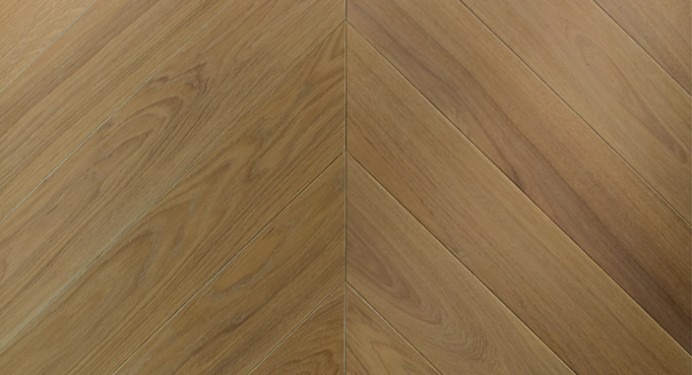
How to choose between solid parquet and engineered floors? |
← |

Choose solid parquet for maximum longevity, heritage restorations, stairs, and multiple refinishing cycles. Choose engineered parquet flooring for underfloor heating compatibility, apartment buildings, Nordic climates, and high dimensional stability. Both systems are manufactured from sustainable European oak by PerfektoWood in Lithuania.
This technical comparison guide evaluates solid wood parquet and engineered parquet flooring to help architects, interior designers, flooring contractors, and developers select the optimal system for residential and commercial projects. As a direct European manufacturer, PerfektoWood produces both solid oak parquet and premium engineered parquet flooring for projects across Europe.
| Technical Factor | Solid Oak Parquet | Engineered Parquet Flooring |
|---|---|---|
| Construction | 100% single-piece solid European oak | European oak wear layer + Baltic birch plywood core |
| Refinish Cycles | 3 to 5 full sanding & refinishing cycles | 1 to 3 cycles (based on 3mm–5.5mm top layer) |
| Dimensional Stability | Moderate — reacts naturally to humidity shifts | Maximum — cross-layered plywood prevents cupping |
| Underfloor Heating | ✖ Not recommended | ✔ Fully compatible |
| Stair Cladding | Preferred — solid edge resistance | Suitable — requires matching stair nosings |
| Installation Method | Full glue-down, site sanding/finishing optional | Full glue-down or floating; factory pre-finished |
| Ideal Application | Heritage renovations, stairs, long-lifecycle luxury | Heated subfloors, modern apartments, commercial fit-outs |
Solid oak parquet is crafted from solid European oak across its entire cross-section. Because the full board depth above the tongue profile acts as a wear layer, it can be sanded and refinished multiple times over decades of use.
Solid parquet is the recommended specification when:
PerfektoWood manufactures solid oak parquet in 16 mm and 22 mm thicknesses across multiple patterns: solid oak boards, solid chevron parquet, solid herringbone, and heavy-duty industrial oak parquet.
Engineered oak parquet construction is built with a selected European oak top layer bonded under hydraulic pressure to a water-resistant Baltic birch plywood core. This multi-layer construction counteracts the natural tangential tension of hardwood, delivering exceptional dimensional stability.
Engineered oak parquet is the recommended specification when:
Explore our complete range of engineered parquet flooring collections, featuring 12 mm, 15 mm, 18.5 mm, and 20.5 mm thicknesses in chevron, herringbone, and straight plank formats with over 30 bespoke finishes. Refer to the engineered parquet grading guide for Select, Nature, and Rustic timber selection.
Property developers and commercial architects specify 2-layer engineered parquet over solid timber for large developments primarily due to dimensional stability over underfloor heating, speed of installation, and significantly lower risk of post-handover callbacks caused by seasonal timber shrinkage. Learn more about layer bonding in our engineered oak parquet construction guide.
Standard manufacturing tolerances, acoustic performance, and compliance metrics for commercial and residential contract specification.
| Parameter | Solid Oak Parquet | Engineered Parquet (2-Layer) |
|---|---|---|
| Standard Thicknesses | 16 mm / 22 mm | 12 mm / 15 mm / 18.5 mm / 20.5 mm |
| Wear Layer (Top Oak) | Full thickness (approx. 6–9 mm above tongue) | 3.0 mm / 4.0 mm / 5.5 mm European Oak |
| Substrate / Core | 100% Solid European Oak (Quercus robur) | Water-resistant Baltic Birch Plywood (WBP) |
| Moisture Content | 7% ± 2% (Kiln-dried EN 13183-1) | 8% ± 2% (Factory conditioned) |
| Thermal Resistance (R-value) | ~0.130 – 0.175 m²K/W | ~0.075 – 0.115 m²K/W (High heat efficiency) |
| Underfloor Heating Suitability | Not recommended | EN 1264 compliant (≤ 27°C surface temp) |
| Fire Classification | Cfl-s1 / Dfl-s1 (EN 13501-1) | Cfl-s1 / Dfl-s1 (EN 13501-1) |
| Formaldehyde Emission | Class E1 (Zero added formaldehyde) | Class E1 / CARB Phase 2 compliant |
| Pattern Configurations | Plank, Herringbone, Chevron (45°/60°), Industrial | Plank (up to 300mm), Herringbone, Chevron (45°/60°) |
* Custom thicknesses, widths, and acoustic backing available for commercial volume orders.
Request Architectural BIM / CAD Files & Tender Specs →Understanding the usable wear layer is essential when calculating long-term lifecycle costs for residential developments and commercial facilities:
In regions such as Sweden, Norway, Finland, Denmark, and the Baltic States, winter indoor heating frequently drops relative humidity down to 25–35%, while summer humidity can exceed 65%.
Under these conditions, solid wood contracts during winter months, potentially opening seasonal gaps between planks. The orthogonal ply structure of engineered oak parquet restricts this movement by up to 70%, ensuring a smooth, tight floor surface year-round.
PerfektoWood operates integrated manufacturing facilities in Lithuania, supplying architects, developers, contractors, and retail partners across Germany, Scandinavia, the Benelux region, France, the UK, and Europe.
Contact our technical sales team to request physical timber samples, acoustic testing data, or project-specific quotes for solid or engineered parquet flooring.
Solid parquet is made from a single piece of hardwood throughout its full thickness, allowing it to be sanded and refinished 3 or more times over its lifetime. Engineered parquet flooring features a real European oak wear layer bonded to a multi-layer birch plywood base, providing superior dimensional stability in varying humidity and over underfloor heating.
Engineered parquet flooring is the only recommended choice for underfloor heating systems. The cross-layered birch plywood base minimises expansion and contraction caused by temperature fluctuations. Solid parquet should not be installed over underfloor heating due to the risk of gapping, cupping, and structural movement.
Solid oak parquet (16mm and 22mm) can typically be sanded and refinished 3 to 5 times over its lifetime. Engineered parquet can be refinished 1 to 3 times depending on the wear layer thickness: a standard 3mm wear layer allows 1 to 2 refinishes, while a 5.5mm wear layer allows 3 or more full refinish cycles.
Engineered parquet flooring performs significantly better in Nordic and Baltic climates (Sweden, Norway, Finland, Baltic States) where indoor humidity shifts drastically between winter heating and summer. The engineered construction resists seasonal shrinking and swelling.
Solid oak parquet is the preferred choice for stairs due to its full-thickness wear layer and edge-wear durability. Industrial solid oak parquet (16x8x160mm) is particularly suited for high-traffic stair treads and commercial nosings.
| ↑ | ← |
| © MB " Perfekto wood" All rights reserved. | Email: info@perfektowood.lt | Mob.: +37065533736 |
|