How to choose between solid parquet and engineered floors? |
← |

Choose solid parquet for maximum longevity, multiple refinishes and stairs. Choose engineered flooring for underfloor heating, humid environments and dimensional stability. Both are available in the same oak species, grades and surface options from PerfektoWood.
This guide compares solid parquet and engineered oak flooring to help architects, interior designers and specifiers choose the right system for each project. PerfektoWood manufactures both solid oak parquet and engineered oak flooring in Lithuania — direct factory supply to Europe.
| Factor | Solid Parquet | Engineered Flooring |
|---|---|---|
| Construction | 100% solid wood throughout | Oak wear layer + birch plywood base |
| Refinishes | more than 3 times over lifetime | 1–3 times (wear layer dependent) |
| Dimensional stability | Medium — reacts to humidity | Very high — plywood base resists movement |
| Underfloor heating | Not recommended | Compatible |
| Stairs | Preferred — full thickness wear layer | Possible — requires correct specification |
| Installation | Glue-down, site finished | Glue-down or floating, factory or site finished |
| Lifetime value | Higher — multiple full refinish cycles | Lower — fewer refinish cycles |
| Best for | Heritage renovations, luxury projects, stairs | Apartments, heated floors, humid environments |
Solid oak parquet is made from a single piece of European oak throughout its full thickness. The entire board is usable wear layer — which is why it can be sanded and refinished more than 3 times over its lifetime, far more than engineered alternatives.
Solid parquet is the correct specification when:
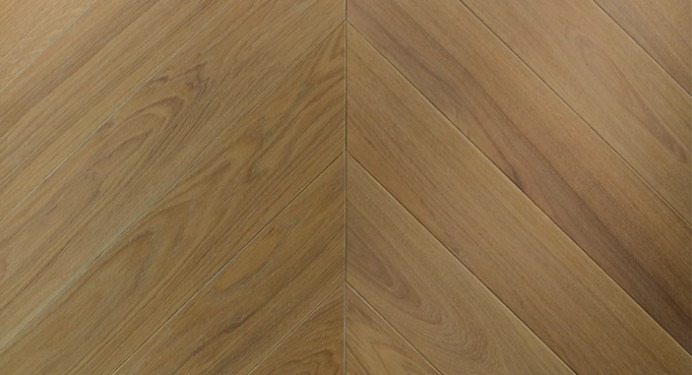
PerfektoWood manufactures solid oak parquet in multiple formats: solid oak boards, solid chevron parquet, solid herringbone and industrial oak parquet.
Engineered oak flooring has a real European oak wear layer (typically 3mm) bonded to a birch plywood base. The multi-layer plywood construction resists the expansion and contraction caused by humidity and temperature changes — making it significantly more stable than solid wood in challenging environments.
Engineered flooring is the correct specification when:
PerfektoWood engineered oak is available in chevron, herringbone and straight board formats with 30+ colour options and three grades. See the full engineered parquet grading guide.
The number of refinish cycles a floor can undergo is one of the most important practical differences between solid and engineered oak — and one that is frequently misunderstood in specification.
Solid oak parquet can be refinished more than 3 times depending on the thickness of the boards. Each sanding cycle removes approximately 0.5–1mm of surface material. A solid 20mm board has significantly more material available than a 3mm engineered wear layer.
Engineered flooring wear layer thickness determines refinishing potential: a 3mm wear layer allows 1 to 2 careful refinishes; a 5.5mm wear layer allows 3 or more. PerfektoWood engineered flooring uses a 3mm European oak wear layer as standard.
For a 30-year project where floor refinishing is expected every 8–10 years, solid parquet is the technically correct long-term specification. For a project where refinishing is unlikely or the floor will be replaced rather than refinished, engineered flooring provides equivalent day-one performance at comparable cost.
In Finland, Norway, Sweden and the Baltic states, seasonal humidity variation is significant — indoor humidity can shift from 30–40% in winter (heating season) to 60–70% in summer. This variation causes solid wood to contract in winter and expand in summer.
Engineered flooring's birch plywood base absorbs the majority of this movement, keeping the surface stable. Properly installed and acclimatised solid parquet also performs well in Nordic climates, but requires more careful humidity management and wider expansion gaps. For projects in these climates with underfloor heating, engineered oak is the only technically sound choice.
PerfektoWood manufactures solid and engineered oak parquet in Lithuania and supplies directly to architects, flooring contractors, developers and construction companies across Europe — Germany, France, Norway, Sweden, Finland, Belgium, the Netherlands, Denmark, the UK and the Baltic states.
Contact us to discuss your project requirements, request samples or technical specifications for both flooring types.
Solid parquet is 100% wood throughout — refinishable more than 3 times, preferred for stairs and heritage projects. Engineered flooring has a real oak wear layer on birch plywood — dimensionally stable, compatible with underfloor heating, available in wide board and chevron formats. See the engineered oak construction guide for full details.
Engineered oak flooring — always. The birch plywood base resists the expansion caused by underfloor heating. Solid parquet should not be used with underfloor heating systems.
more than 3 times over its lifetime. Engineered flooring: 1–3 times depending on wear layer thickness (3mm wear layer = 1–2 refinishes). For projects where long-term refinishing is planned, solid parquet provides greater lifecycle value.
Engineered flooring generally performs better in Finland, Norway and Sweden due to significant seasonal humidity variation. Solid parquet performs well when properly acclimatised and installed, but requires more humidity management over time.
Solid oak parquet is the preferred choice for stairs — full-thickness wear layer, glue-down installation, maximum edge wear resistance. Industrial oak parquet 16x8x160mm is particularly suitable for stair treads.
| ↑ | ← |
| © MB " Perfekto wood" All rights reserved. | Email: info@perfektowood.lt | Mob.: +37065533736 |
|